
Food recommendations
Food Pyramid
Ireland uses a food pyramid which is developed by the Food Safety Authority of Ireland. The food pyramid is designed to show people what they are supposed to eat on a day and how much they should eat of different food groups.
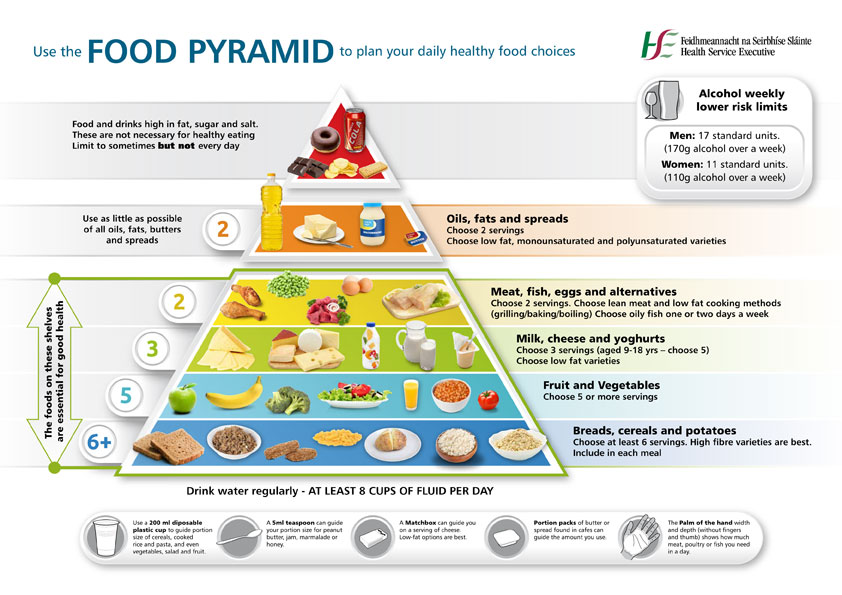
The pyramid contains 5 different food groups. It also contains one extra group which is advised not to eat too much and too often, as people don’t need this food group for growth and maintenance (see Table 1)
Table 1
|
Group |
Advise |
Number of serving, Men |
Number of serving, Women |
|
Cereals, Breads, Potatoes, Pasta and rice group |
Choose wholemeal for fibre and healthiest calories. |
Active: 5-7 Sedentary: 4-6 |
Active: 4-5 Sedentary: 3-4 |
|
Fruit, vegetables and Salads group |
Choose a variety of colors for the best mix of protective nutrient. |
5-7 |
5-6 |
|
Milk, Yoghurt and Cheese group |
Great for calcium for healthy bones. Choose low-fat foods from this group. |
3-5 |
3 |
|
Meat, Poultry, Fish and Alternatives group |
Rich in protein, iron and -in the case of oily fish- vitamin D and protective fatty acids. Choose lean meat for iron. Take fish twice a week - oily is best. |
Mail meal: 1 Light meal: 1-2 |
Main meal: 1 Light meal: 1 |
|
Fats, Spreads and Oils group |
Limit use of all fats and oils and choose low-fat polyunsaturated or monounsaturated types where possible. |
Use a reduced-fat spread sparingly. Use oils sparingly. |
Use a reduced-fat spread sparingly. Use oils sparingly. |
|
Other Foods that are not Necessary for Healthy Eating |
NOT too MUCH and NOT too OFTEN. These foods are high in calories, fat, sugar and salt, and need to be limited. |
|
|
Table 1. Food Pyramid, the recommendations are for people in the age of 18-15 years.
The Food Safety Authority of Ireland has also made food recommendations of calorie, fat, saturated fat, sugar, fibre, iron, calcium and vitamin D intake
(see Table 2)
|
Gender Age (years) |
Calories, inactive |
Calories moderately active |
Total fat (% energy) |
Saturated fat (% energy) |
Sugars (% energy) |
Fibre (g) |
Iron (mg) |
Calcium (mg) |
Vit D(μg) |
|
Boys/girls (5-13) |
N/A |
1400-2200 |
25-35 |
≤10 |
≤10 |
Age + 5 |
8-11 |
800-1300 |
5 |
|
Boys (14-18) |
2200 |
2400-2800 |
20-35 |
≤10 |
≤10 |
Age + 5 |
7 |
1300 |
5 |
|
Girls (14-18) |
1800 |
2000 |
20-35 |
≤10 |
≤10 |
Age + 5 |
10 |
1300 |
5 |
|
Men (19-50) |
2200 |
2400-2800 |
20-35 |
≤10 |
≤10 |
≥25 |
7 |
1000 |
5 |
|
Women (19-50) |
1800 |
2000-2200 |
20-35 |
≤10 |
≤10 |
≥25 |
10 |
1000 |
5 |
|
Men (51+) |
2000 |
2200-2400 |
20-35 |
≤10 |
≤10 |
≥25 |
7 |
1200 |
10 |
|
Women (51+) |
1600 |
1800 |
20-35 |
≤10 |
≤10 |
≥25 |
6 |
1200 |
10 |
Table 2. Goals for different age and gender groups in the Irish population
To eat healthy with the recommendations of micro- and macronutrients the Food Safety Authority of Ireland put some basic healthy eating guidelines on paper. The guidelines are as follows:
1. Eat a wide variety of foods from the five food groups.
2. Be physically active every day.
3. Choose smaller serving sizes and add plenty of vegetables, salad and fruit.
4. Plain wholemeal breads, cereals, potatoes, pasta and rice provide the best calories for a healthy weight.
5. Eat plenty of different coloured vegetables, salad and fruit – at least five a day.
6. Low-fat milk, yoghurt and cheese are best – choose milk and yoghurt more often than cheese.
7. Choose lean meat and poultry; include fish (oily is best) and remember, peas, beans and lentils are good alternatives.
8. Use polyunsaturated and monounsaturated spreads and oils sparingly – reduced fat spreads are best.
9. Grill, bake, steam or boil food, instead of frying or deep frying.
10. Healthy eating can be enjoyed with limited amounts of ‘other foods’ like biscuits, cakes, savoury snacks and confectionery.
11. Limit your salt intake.
12. Drink plenty of water.
13. Everyone should take a daily vitamin D supplement. 5μg per day for those aged 5-50 years and 10μg per day for those aged 51 years and over.
14. All women of childbearing age who are sexually active should take a folic acid supplement (400 micrograms (μg)) every day to help prevent neural tube defects (NTDs) in babies, e.g. Spina Bifida.
15. Breastfeeding should be encouraged and supported by everyone in Ireland because it gives babies the very best start in life and helps protect women’s health.
16. Prepare and store food safely.
Sources: Food Safety Authority of Ireland, Nutrition and Health Foundation, Safefood